Finding The Best Game
Fourth suit forcing is useful for when you're not sure what contract you want to be in or you just want to find a way of keeping the bidding going when you're interested in bidding a slam.
Points - But Where Do We Go?
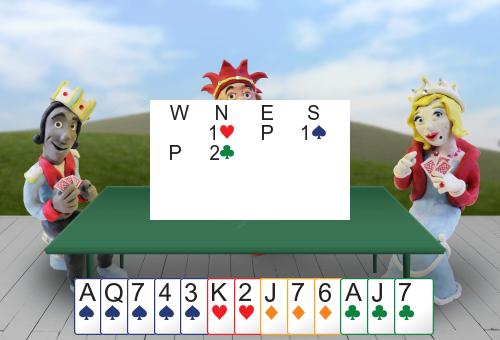
1♥ from North, so we are bidding to game. I just don't know which game to bid yet so i'll start with 1♠. North bids 2♣ and I still don't know which game to bid. I could bid three 3NT, but my diamond suit's a little dodgy and I do have a five card spade suit. Maybe 4♠ is the right contract. Maybe 4♥, maybe 5♣.
More Information Please
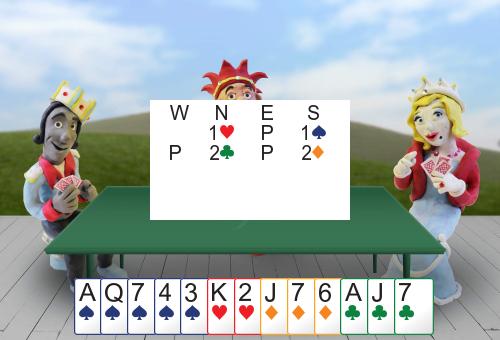
Because I don't know I'm going to just explore a little more and I'm going to bid the fourth suit. Notice hearts, spades and clubs have been bid already. When I bid the fourth suit it doesn't necessarily have to be a four card suit. But it is forcing so I can get a little bit more information from North.
North Shows Something In Diamomds
And that's fine. If North had spade support or partial spade support he would have bid spades. So North will have something in diamonds and that's good enough for me.
We're In The Best Contract
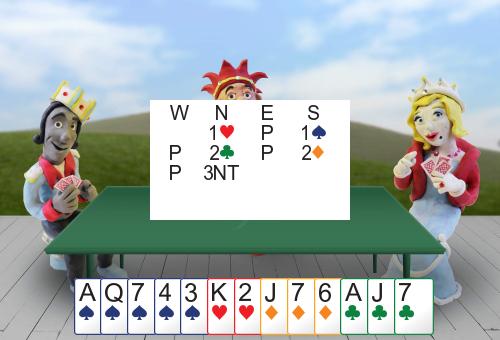
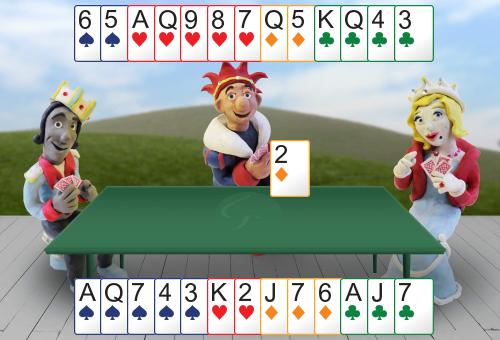
Well, North didn't have a lot in diamonds! But it's enough.
Fourth Suit Forcing: One Round vs. Game Force
Some partnerships use Fourth Suit Forcing (4SF) as forcing for one round (F1R) while others play it as game forcing (GF). This alters what kind of hand a player should have when they use the convention, and how the partnership communicates afterward.
The One-Round Force (The Traditional Approach)
In the traditional approach - originally developed in the UK and still favored by many traditional Acol players - bidding the fourth suit is only forcing for one round and does not commit the partnership to game.
This solves the "Invitational Hand Problem." If responder has a good 10–11 HCP (high card points) and an awkward distribution, they can use 4SF to investigate the best denomination. If opener shows a minimum hand and no fit, responder can pass the rebid, safely stopping in a partscore.
The disadvantage is that because the auction isn't forced to game, responder must eventually differentiate an invitational hand from a game going hand. To show a truly strong hand (13+ HCP), responder has to make a jump bid on their next turn. Jumping uses vital bidding space below game, which makes it much harder to investigate slam or find the absolute best contract on powerful hands.
The Game Force (The Modern Expert Standard)
Most modern tournament players, particularly those playing Standard American or 2/1 Game Force, play 4SF as an absolute game force. Once the fourth suit is bid, neither player is allowed to pass until a game contract is reached.
The big advantage is bidding space. Because game is already guaranteed, responder never has to jump to prove they have values. Both players can bid naturally, economically, and step-by-step at the cheapest possible level to exchange information. This is useful for finding 5-3 major suit fits, checking for specific stoppers, or exploring slam. It also frees up actual jump bids after 4SF to mean something highly specific (like showing 16+ HCP and slam interest) rather than just a generic game going hand.
The disadvantage is that it leaves responder in a bind with a classic 11-point invitational hand that has no obvious rebid (e.g., no stopper in the fourth suit to bid 2NT, and no support for opener's suits). Under this system, responder is forced to guess, either by making a conservative, non forcing "false preference" rebid to show a weak hand, or by overbidding to a game force and hoping opener has extra values.
What's Best?
Regional traditions and scoring methods often dictate the preference. In IMP scoring, where bidding tight games is heavily rewarded, the game forcing version is almost universally preferred by experts. In matchpoints, where stopping in a safe 2 level contract can earn you a top score when game is down at other tables, a one round force still has merit.
No real right or wrong. Just make sure you discuss it with your partner.