How To Use Blackwood
Here's an example of Blackwood in action.
Shape And Strength First
North has opened 1♦ and we have 15 high card points. So to start with I'm just going to bid 1♠ and North bids 3♠. North will have around about 16 or 17 points. So in our heads, let's just think 16 for now. We're up to 31.
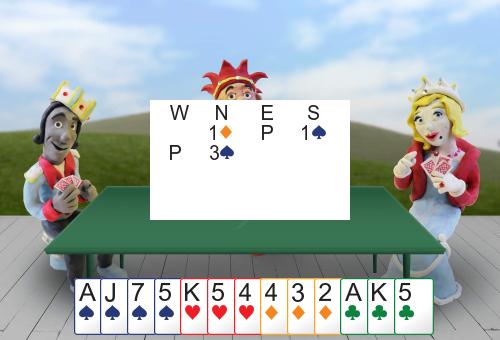
31 points just isn't enough to bid a slam, no matter how many aces we've got, when we've got a very balanced hand like this. With a balanced hand we're going to need 33 points to make a slam and we're just going to get there with brute force, all that strength.
If we want to bid a slam with fewer than 33 points we need something extra and we don't have it.
Slam Potential
Now we're talking. So once again I've had 1♠, 3♠ from North our partner and we have around about 31 high card points but we do have something extra.
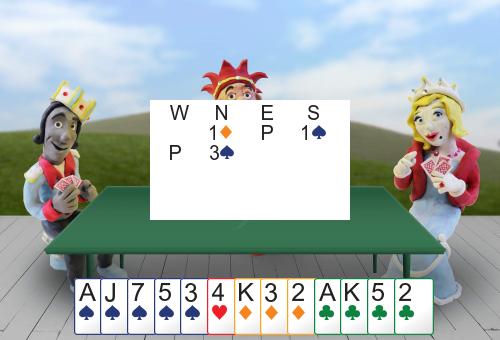
We've got a five card spade suit. We've got a singleton heart. The ♦K matches up with partner's 1♦ opening so hopefully that's going to make the diamond suit easier to run as a side suit. We only have one heart loser.
Despite the fact that we don't have 33 high card points between the two hands we have 31 with something extra so I think we're strong enough to bid slam.
There's something else good about this hand. Notice that we have the ♠A so we can win the first trick in the spade suit. We're said to have first round control in the spade suit.
We have one heart which is good because we can only lose one heart trick. If the opposition play the ♥A and the ♥K we can ruff that second heart. So we have second round control in the heart suit. We can't win the first heart trick but we can win the second heart trick so we have second round control.
We've got first round control in the club suit with the ♣A and we've got second round control in the diamond suit. So yep we're missing the ♦A but we do have the ♦K. What that means is that we have first or second round control in every suit.
Great, so we have the strength to bid slam. We have first or second round control in every suit. The only thing that could go wrong now is that we're missing two aces, the ♥A and the ♦A.
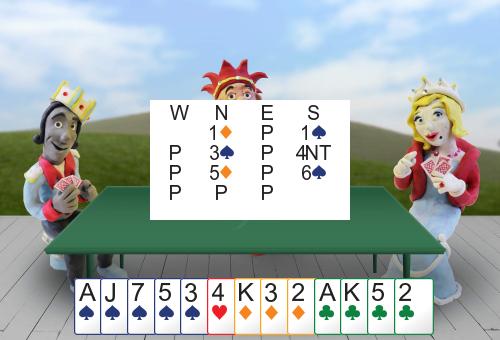
It's no good bidding six spades if we lose the first two aces. With 33 points this wouldn't be a problem because if we have 33 points we're only missing seven points. We can't be missing two aces because that would be eight points. With our 31 high card points we've got a bit of a problem. So we can introduce Blackwood the Ace Asking Convention.
Asking For Aces
So we bid 4NT and 5♦ from partner shows one ace. We are only missing one ace and so I can bid 6♠
Slam Makes
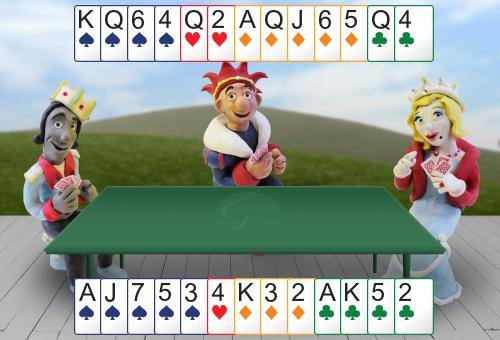
We are just missing the ♥A and after this first trick lost we are going to get the rest.
Understanding the Difference Between Blackwood and Gerber
Blackwood and Gerber are two common ace asking conventions in bridge. What's the difference? Which one is best?
Gerber uses 4♣ to ask partner for aces. The responses are:
- 4♦ - 0 or 4 Aces
- 4♥ - 1 Ace
- 4♠ - 2 Aces
- 4NT - 3 Aces
Which One Should I Use?
At first glance Gerber looks pretty good because it keeps the bidding lower. However, expert players rarely use this convention. Why not?
The biggest downside of Gerber is that it takes away the valuable 4♣ bid that could be used in many more helpful ways. Cue bidding or splinters, for example, both of which are great slam bidding tools. Heck, 4♣ as a natural bid showing clubs is often exactly what you'd like to be able to do on a hand.
Blackwood starts at a higher level, meaning that the response will take you higher, but rushing off to ask for aces often isn't the best way to explore slam.